
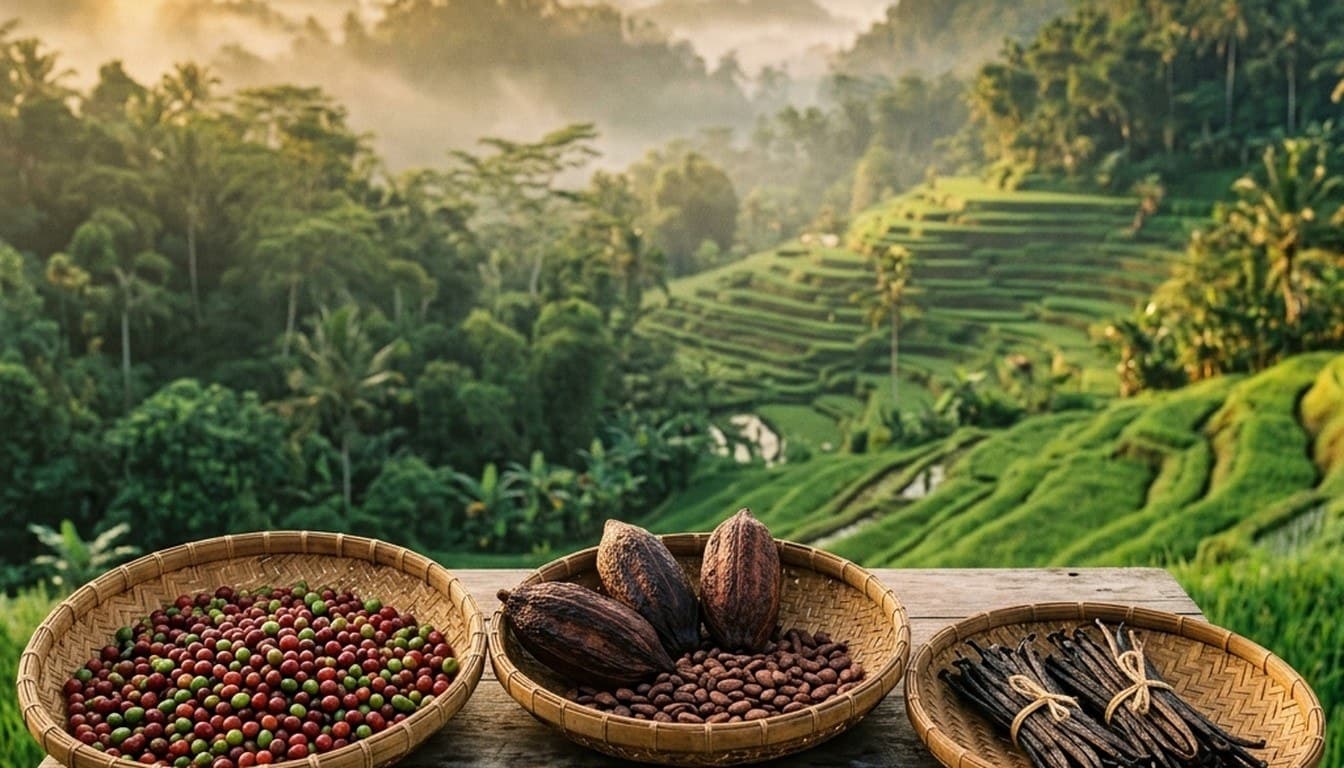
The Agriculture Opportunity in Indonesia
Indonesia's agriculture sector represents 13.3% of GDP and employs 29% of the workforce. The KBLI 2025 classification system introduces 141 specialized agriculture codes under Category A (01xxx), providing foreign investors with unprecedented clarity on PMA ownership rules, risk classifications, and operational boundaries.
For Bali specifically, agriculture intersects with tourism to create the "agritourism" model — coffee plantations that host visitors, organic farms offering workshops, and livestock operations integrated with eco-resorts. This article dissects the KBLI codes that enable these business models.
Understanding Category A: Agriculture Structure
KBLI 2025 divides agriculture into 7 major groups, each with dozens of five-digit sub-classifications:
| Group | KBLI Range | Coverage | Typical PMA | Risk Level |
|---|---|---|---|---|
| 01.1 | 01111-01199 | Food crops (rice, corn, vegetables) | 100% | Low |
| 01.2 | 01211-01299 | Plantations (coffee, tea, cacao, palm oil) | 100% | Low |
| 01.3 | 01301-01399 | Plant breeding, nurseries, horticulture | 49%-100% | Low |
| 01.4 | 01410-01490 | Livestock (cattle, buffalo, goat, poultry) | 100% | Low |
| 01.5 | 01500 | Mixed farming (crops + livestock) | 100% | Low |
| 01.6 | 01611-01699 | Agricultural support services (machinery, storage) | 100% | Low |
| 01.7 | 01701-01799 | Post-harvest activities (hunting, animal breeding) | 100% | Low |
Key insight: Unlike real estate (where 5 codes expanded to 14), agriculture codes remain stable with 141 classifications. The government is not restricting access — it's formalizing existing activities.
Food Crops (01.1): Staples and Vegetables
This group covers cereal grains, legumes, and vegetables. Most codes allow 100% PMA with Low risk.
Sample Codes: Food Crops
| KBLI | Title (Bahasa) | Title (English) | PMA | Risk |
|---|---|---|---|---|
| 01111 | Pertanian Jagung | Corn farming | 100% | Low |
| 01112 | Pertanian Ubi Kayu/Singkong | Cassava farming | 100% | Low |
| 01133 | Hortikultura Sayuran Buah | Fruit vegetable horticulture | 100% | Low |
| 01134 | Hortikultura Sayuran Daun | Leafy vegetable horticulture | 100% | Low |
| 01135 | Hortikultura Sayuran Kacang-Kacang | Legume horticulture | 100% | Low |
| 01138 | Tanaman Obat-Obatan | Medicinal plant cultivation | 100% | Low |
Bali application: Organic vegetable farms (01133, 01134) are increasingly popular in Ubud and Tabanan. Register as 01133 for the farm operation, then add 47911 (Retail via e-commerce) to sell produce online or 79110 (Travel agency) for farm-to-table tours.
Plantations (01.2): Coffee, Cacao, and Cash Crops
Indonesia is the world's 4th largest coffee producer and 2nd largest cocoa producer. Plantation codes are among the most strategically important for foreign investors targeting export markets.
Sample Codes: Plantations
| KBLI | Title (Bahasa) | Title (English) | PMA | Risk |
|---|---|---|---|---|
| 01211 | Pertanian Tebu | Sugarcane farming | 100% | Low |
| 01252 | Buah Biji Kacang-Kacangan | Nut fruits cultivation | 100% | Low |
| 01284 | Perkebunan Tanaman Aromatik/Penyegar | Aromatic/refreshing plantation (coffee) | 100% | Low |
| 01285 | Perkebunan Kelapa Sawit | Palm oil plantation | 100% | Low |
| 01286 | Perkebunan Karet | Rubber plantation | 100% | Low |
Critical code: 01284 — This code covers coffee, tea, and cacao. It's the legal basis for Bali's famous "coffee plantations" that double as tourist attractions. 100% PMA, Low risk, and no minimum investment for non-priority sectors.
Coffee Plantation + Agritourism Strategy
A typical Bali coffee plantation operates under a multi-KBLI structure:
- 01284 — Primary code for coffee cultivation and processing
- 79110 — Travel agency services for organizing tours
- 56101 — Restaurant services for on-site cafe
- 47911 — E-commerce retail for online coffee sales
This structure allows you to:
- Grow and process coffee beans (01284)
- Host paid tours with tasting sessions (79110)
- Operate a cafe serving meals (56101)
- Sell packaged coffee online (47911)
License requirement: The "plantation + tour" model only requires a Low risk NIB (Nomor Induk Berusaha) for 01284 and 79110. High risk codes like food processing (10xxx) are NOT required if you're only roasting beans for immediate consumption on-site.
Plant Breeding and Nurseries (01.3): The PMA Exception
This group includes nurseries, seedling production, and plant propagation. It contains one of the few PMA-restricted agriculture codes.
Sample Codes: Plant Breeding
| KBLI | Title (Bahasa) | Title (English) | PMA | Risk |
|---|---|---|---|---|
| 01301 | Tanaman Hias | Ornamental plant growing | 100% | Low |
| 01302 | Pengembangbiakan Tanaman | Plant breeding | 49% | Low |
| 01303 | Pembibitan Tanaman Pangan | Food crop seedling | 100% | Low |
| 01726 | Penangkaran Anggrek | Orchid breeding | 100% | Low |
Critical restriction: 01302 — Plant breeding for genetic improvement is limited to 49% foreign ownership. This protects Indonesia's seed sovereignty under Law No. 22/2019 (Plant Genetic Resources Protection).
Workaround: If you want to run a premium orchid export business (popular in Bali), use 01726 (Orchid breeding), which allows 100% PMA. The "breeding" in 01726 refers to propagation for commercial sale, not genetic modification.
Livestock (01.4): Cattle, Poultry, and Animal Husbandry
Indonesia's growing middle class drives demand for protein. Livestock codes allow 100% PMA with Low risk across all categories.
Sample Codes: Livestock
| KBLI | Title (Bahasa) | Title (English) | PMA | Risk |
|---|---|---|---|---|
| 01410 | Ternak Sapi Perah | Dairy cattle farming | 100% | Low |
| 01421 | Ternak Sapi Potong | Beef cattle farming | 100% | Low |
| 01422 | Ternak Kerbau | Buffalo farming | 100% | Low |
| 01430 | Ternak Kuda dan Hewan Sejenisnya | Horse farming | 100% | Low |
| 01440 | Ternak Kambing dan Domba | Goat and sheep farming | 100% | Low |
| 01460 | Unggas Ayam | Chicken farming | 100% | Low |
| 01470 | Lebah Madu | Honeybee keeping | 100% | Low |
Bali application: Organic beef (01421) and goat (01440) farms are emerging as eco-tourism attractions. Combine with 93219 (Recreation parks) to operate an "animal sanctuary" where tourists interact with rescued livestock.
Livestock Support Services (01.6)
Support services are separated from primary production:
| KBLI | Title (Bahasa) | Title (English) | PMA | Risk |
|---|---|---|---|---|
| 01611 | Jasa Penunjang Pertanian | Agricultural support | 100% | Low |
| 01629 | Jasa Penunjang Peternakan | Livestock support | 100% | Low |
| 01630 | Jasa Penunjang Pasca Panen | Post-harvest support | 100% | Low |
Business model: If you don't want to own the farm, register as 01629 (Livestock support) and offer consulting, veterinary referrals, or feed supply. This is the "SaaS for agriculture" model — no land ownership required, 100% PMA, Low risk.
Agritourism: The Multi-KBLI Strategy
Agritourism businesses combine agriculture operations with visitor experiences. The OSS system (Online Single Submission) allows you to register up to 5 KBLI codes on a single NIB, creating a legal framework for diversified revenue.
Agritourism Model 1: Coffee Plantation + Tours
Business: Coffee farm with guided tours, tastings, and on-site cafe.
KBLI structure:
- 01284 (Primary) — Coffee plantation
- 79110 — Travel agency/tour services
- 56101 — Restaurant/cafe
- 10839 — Tea and coffee processing (if selling packaged products)
PMA: 100% on all codes Risk: Low (01284, 79110) + Medium (56101, 10839) License: NIB covers all 4 codes; Medium risk codes trigger food safety certification (BPOM)
Agritourism Model 2: Organic Farm + Workshops
Business: Organic vegetable farm with farm-to-table cooking classes.
KBLI structure:
- 01133 (Primary) — Fruit vegetable horticulture
- 85496 — Educational courses (non-formal)
- 56101 — Restaurant (for cooking class meals)
- 47911 — E-commerce retail (for produce sales)
PMA: 100% on all codes Risk: Low (01133, 47911) + Medium (85496, 56101) License: NIB + teaching permit (for 85496) + food safety cert (for 56101)
Agritourism Model 3: Livestock Sanctuary + Eco-Resort
Business: Animal rescue center with on-site accommodation and educational programs.
KBLI structure:
- 01440 (Primary) — Goat and sheep farming
- 55101 — Hotel/accommodation
- 93219 — Recreation and amusement parks
- 85496 — Educational courses (animal care workshops)
PMA: 100% on all codes Risk: Low (01440) + Medium (55101, 93219, 85496) License: NIB + hospitality permits (for 55101) + education permit (for 85496)
Key principle: Your primary KBLI determines your company's tax classification. If 01440 (livestock) is primary, you're taxed as an agriculture business, which may qualify for tax incentives under Law No. 6/1983 (General Tax Provisions).
Land Ownership: The Hak Pakai Requirement
Critical legal constraint: Foreigners and foreign-owned PT PMA companies cannot own land (Hak Milik) in Indonesia. Agriculture businesses must use one of three legal structures:
Option 1: Hak Pakai (Right to Use)
Structure: PT PMA holds Hak Pakai title, valid for 30 years, renewable for 20 more. Use case: Best for plantation businesses (coffee, cacao) where you control the land long-term. Process: Apply via BPN (National Land Agency) with approved NIB showing agriculture KBLI.
Option 2: Lease (Sewa)
Structure: Indonesian citizen or local entity owns land (Hak Milik), PT PMA leases for up to 25 years. Use case: Suitable for agritourism where you don't need permanent ownership (farm tours, workshops). Process: Standard lease agreement, notarized, registered with local land office.
Option 3: Contract Farming
Structure: PT PMA contracts with local farmers who own land; PT PMA provides seeds/tech/market access. Use case: Low-capital model for vegetable/fruit export businesses (01133, 01134). Process: Farming agreements under Ministry of Agriculture guidance (Permentan 03/2017).
Recommendation for foreigners: Start with Option 2 (Lease) for your first 3-5 years. This minimizes upfront capital and de-risks land disputes. Once cash flow is proven, convert to Hak Pakai (Option 1) for long-term security.
Capital Requirements and Investment Incentives
Minimum Capital (BKPM Regulation 5/2025)
| KBLI Range | Business Type | Min. Paid-Up Capital | Min. Total Investment |
|---|---|---|---|
| 01111-01799 | Agriculture (general) | IDR 10 billion | None |
| 01284 | Plantation (priority) | IDR 10 billion | IDR 100 billion* |
*Priority sectors (coffee, cacao, rubber) under Presidential Regulation 10/2021 (Tax Holiday) require IDR 100 billion total investment to qualify for CIT Holiday (0% for 5-10 years).
Non-priority agriculture (vegetables, livestock support) requires IDR 10 billion paid-up capital but has no minimum total investment. This is the lowest barrier to entry in Indonesian PMA.
Tax Incentives (Law No. 2/2020 - Job Creation Law)
| Incentive | Eligibility | Benefit |
|---|---|---|
| Tax Holiday | Priority plantation (IDR 100B investment) | 0% CIT for 5-10 years |
| Tax Allowance | Agriculture processing (e.g., coffee mills) | 30% asset depreciation deduction |
| Import Duty Cut | Capital goods for agriculture | 0% import duty on machinery |
| Super Deduction | R&D (plant breeding, organic methods) | 300% deduction of R&D expenses |
How to qualify: Submit application to BKPM (Investment Coordinating Board) within 1 year of NIB issuance. Include investment realization proof (land lease, machinery invoices) and business plan showing job creation targets.
Bali-Specific Opportunities
1. Coffee Plantations (Kopi Luwak and Specialty Coffee)
KBLI: 01284 (Aromatic plantation) + 79110 (Tours) Market: Bali produces ~5,000 tons/year of Arabica and Robusta. Global specialty coffee market growing 12% annually. Location: Kintamani (North Bali) — UNESCO Global Geopark status adds tourism appeal. Investment: ~IDR 15-20 billion for 5-hectare plantation + processing + cafe.
2. Cacao Plantations
KBLI: 01284 (Aromatic plantation) + 10820 (Cacao processing) Market: Bali cacao known for high-quality fermentation. Direct export to EU/US chocolatiers. Location: Tabanan, Jembrana (West Bali). Investment: ~IDR 25 billion for 10-hectare plantation + fermentation facility.
3. Organic Vegetable Farms
KBLI: 01133 (Fruit veg horticulture) + 47911 (E-commerce) Market: Bali's expat and tourist population drives demand for organic produce. Farm-to-table restaurants pay 2-3x wholesale prices. Location: Bedugul, Canggu (proximity to high-end restaurants). Investment: ~IDR 5-8 billion for 1-hectare hydroponic/organic farm + online sales platform.
4. Livestock Sanctuaries
KBLI: 01440 (Goat/sheep) + 93219 (Recreation parks) Market: Animal welfare tourism growing post-COVID. Families seek educational experiences for children. Location: Ubud (cultural tourism hub). Investment: ~IDR 10-12 billion for 2-hectare sanctuary + visitor facilities.
Risk Management: Common Pitfalls
Pitfall 1: Mixing Production and Processing Codes
Problem: Registering 01284 (Coffee plantation) and 10839 (Coffee processing) as equal primary codes. Result: OSS system flags you for industrial processing permits (SIUP Industri), which require environmental impact assessments.
Solution: Make 01284 primary (60%+ of revenue from cultivation). Register 10839 as secondary for "on-site roasting" only. This keeps you in Low risk category.
Pitfall 2: Tour Operations Without 79110
Problem: Running paid tours under agriculture code only (01284). Result: Tax office classifies tour revenue as "illegal services" — subject to fines and back taxes.
Solution: Always add 79110 (Travel agency) as secondary code if you charge entrance fees or tour packages. This is non-negotiable for agritourism models.
Pitfall 3: E-Commerce Sales Without Retail Code
Problem: Selling produce online without 47911 (E-commerce retail) registered. Result: BPOM (food safety agency) may reject product certification because your NIB doesn't cover "retail trade."
Solution: Register 47911 as tertiary code. This adds zero additional cost but makes your NIB compliant for online sales platforms (Tokopedia, Shopee, own website).
Comparison: Agriculture vs. Other Sectors
| Factor | Agriculture (01xxx) | Real Estate (68xxx) | F&B (56xxx) |
|---|---|---|---|
| PMA Access | 100% (most codes) | 100% (most codes) | 100% |
| Risk Level | Low | Low-Medium | Medium-High |
| Min. Capital | IDR 10B | IDR 10B | IDR 10B |
| Land Ownership | Hak Pakai only | Hak Pakai only | Lease/Strata |
| Tax Incentives | Yes (plantations) | No | Limited |
| License Timeline | 2-4 weeks | 4-8 weeks | 8-12 weeks |
Takeaway: Agriculture codes are among the fastest and cheapest to license. The 2-4 week NIB processing for Low risk codes makes agritourism one of the most accessible business models for foreign investors.
Implementation Checklist
Step 1: Business Model Design (Week 1-2)
- Define primary revenue stream (plantation, livestock, or farm tours)
- Map KBLI codes to each revenue line (max 5 codes)
- Determine primary KBLI (must represent 60%+ of revenue)
Step 2: Land Acquisition (Week 3-8)
- Secure land via lease (Sewa) or Hak Pakai application
- Verify land zoning allows agriculture use (check RTRW - Spatial Plan)
- Register land lease with local Notaris and BPN
Step 3: PT PMA Formation (Week 9-12)
- Submit NIB application via OSS with agriculture KBLI codes
- Deposit minimum paid-up capital (IDR 10 billion) to company bank account
- Obtain NIB (includes business license, tax ID, importer ID if needed)
Step 4: Operational Permits (Week 13-16)
- Apply for sectoral permits if Medium/High risk codes (e.g., BPOM for food processing)
- Register with Ministry of Agriculture for plantation codes (01284, 01285)
- Obtain local business permit (Izin Usaha) from Kabupaten/Kota government
Step 5: Tax Incentive Application (Optional, Week 17-20)
- Prepare investment realization proof (land docs, machinery invoices)
- Submit Tax Holiday or Tax Allowance application to BKPM
- Coordinate with tax office (KPP) for incentive activation
Total timeline: 4-5 months from business plan to operational status.
The Bottom Line
KBLI 2025's 141 agriculture codes provide foreign investors with a clear roadmap to Indonesia's agriculture and agritourism sectors. The key strategic insights:
-
100% PMA dominance — Only 1 code (01302 plant breeding) restricts foreign ownership to 49%. All other codes allow full foreign control.
-
Low risk = fast licensing — Most agriculture codes carry Low risk classification, meaning 2-4 week NIB processing with minimal sectoral permits.
-
Multi-KBLI advantage — Agritourism thrives on code combinations. Register 3-4 codes (plantation + tour + cafe + retail) to capture diversified revenue.
-
Land workaround — You can't own land, but Hak Pakai (30 years) or long-term lease (25 years) provides sufficient security for ROI.
-
Tax incentives available — Priority plantations (coffee, cacao, rubber) qualify for 0% CIT Holiday if you invest IDR 100 billion+.
For Bali specifically, the intersection of agriculture and tourism creates a "premium commodity" play — you're not just selling coffee beans, you're selling the experience of walking through a plantation at sunrise with Mount Batur in the background. KBLI 2025 finally gives that business model a legal structure.
The June 2026 migration window has closed. If you're operating an existing agriculture business under KBLI 2020, audit your codes now and prepare the transition. If you're a new investor, this is the optimal time to enter — the regulatory framework is settled, and the agritourism market in Bali is only beginning to mature.
Topics
- kbli 2025
- agriculture Indonesia
- agritourism Bali
- coffee plantation
- organic farming
- PMA agriculture
- livestock business
- eco-tourism

Zantara AI
AI Business Advisor
Questions about how this applies to your case?
Bali Zero handles visas, company setup, tax and property compliance in Indonesia. Ask us directly on WhatsApp.
Chat with Bali Zero on WhatsApp