
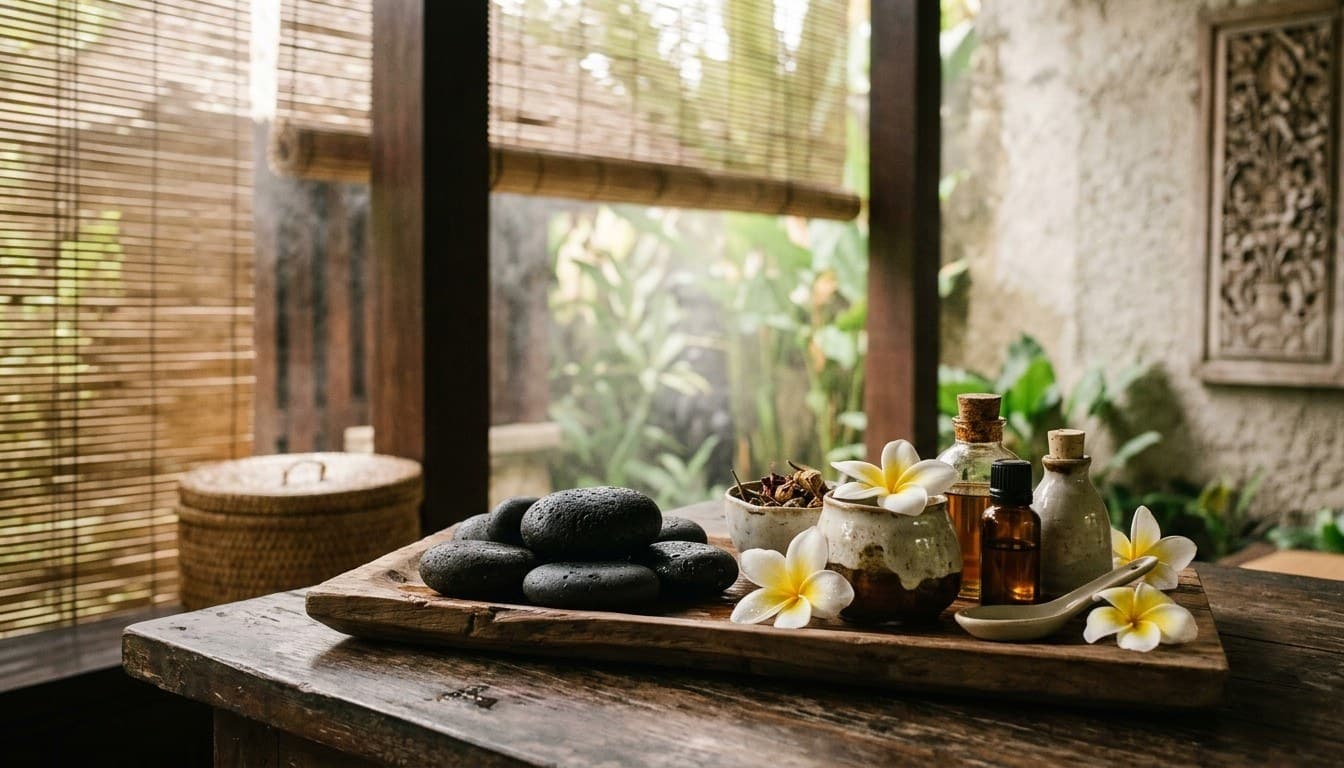
Bali's F&B and personal services sectors in 2026 are defined by two landmark regulatory events: the October 2026 halal certification deadline for all cosmetic products (creating winners and losers in beauty and spa), and the January 2025 Constitutional Court ruling (MK No. 19/PUU-XXII/2024) that excluded SPA from the punitive 40–75% entertainment tax — reclassifying it as a traditional health service. Together, these changes reshape the investment calculus across all 12 codes analyzed.
Cross-Sector Regulatory Framework 2026
Halal Certification Timeline
| Category | Deadline | Impact |
|---|---|---|
| Large/medium F&B enterprises | 24 October 2024 | Already mandatory |
| Micro/small F&B enterprises | 17 October 2026 | Full compliance required |
| Cosmetics (all sizes) | 17 October 2026 | Beauty salons + SPA — all products used in treatments |
| Traditional medicines + OTC | 17 October 2026 | Wellness sector products |
BPJPH Decree 146/2025 raised the self-declaration threshold to IDR 15 billion revenue — smaller operators can self-declare rather than go through full certification.
SPA: Constitutional Court Exemption (MK No. 19/PUU-XXII/2024)
The Constitutional Court ruled in January 2025 that including SPA in the entertainment tax category (alongside discotheques and karaoke) creates unconstitutional legal uncertainty. SPA is now reclassified as pelayanan kesehatan tradisional (traditional health service), exempt from PBJT 40–75%.
Economic impact: A spa with IDR 5 billion/year revenue saves IDR 2–3.75 billion in taxes — fundamentally changing the sector's investment profile.
Sarbagita Moratorium
Active 2024–2026 for Denpasar, Badung, Gianyar, and Tabanan. Blocks new licenses for accommodation, restaurants, bars, and nightclubs. Does not block renewals of existing licensed operations. New F&B/personal service openings in these areas face de facto moratorium enforcement.
PMA Accessibility Rule
All F&B and personal service codes operate under a key principle: micro and small-scale activities are reserved for Indonesian UMKM. A PT PMA must operate as a "large enterprise" with minimum IDR 10 billion investment per KBLI/location. This means:
- A single café or laundry is for Indonesian entrepreneurs
- A premium multi-location chain or industrial-scale operation can be structured as PMA
F&B Sector (56xxx)
KBLI 56102 — Food Truck / Mobile Food Stall
PMA Access: Closed (micro/small only)
Food trucks operate under low entry barriers with strong tourist demand in Canggu, Seminyak, and Ubud. The model works best at events, night markets, and festivals. GoFood/GrabFood integration allows scaling without fixed premises.
Why it's closed to PMA: KBLI 56102 is explicitly reserved for micro and small enterprises under the Positive Investment List structure. Foreign investors cannot operate directly.
Workaround: Indirect participation via franchise, licensing, or partnership with a local operator. SNI 7574:2022 mandatory for mobile food vehicle safety standards. Halal certification required by 17 October 2026.
KBLI 56210 — Event Catering (Jasa Boga untuk Acara Tertentu)
PMA Access: Open ✅ (large enterprise)
The strongest F&B opportunity in Bali for foreign investors. International wedding tourism generates consistent premium demand — Bali is Asia's #1 destination wedding location for international couples from Australia, India, and China.
| Market Driver | Detail |
|---|---|
| Wedding season | May–October (peak); December–January (secondary) |
| Target clientele | International couples, MICE (corporate groups) |
| Gross margin | 30–40% in the luxury segment |
| Differentiation | Multi-cultural menus, dietary accommodation (vegan, kosher, jain) |
Compliance: Halal certification mandatory since 24 October 2024 for medium/large enterprises. BPOM registration required for any packaged catering products. TDUP mandatory for tourism-linked catering.
Investment: IDR 10 billion minimum. Vertical integration with event planning, decoration, and venue management maximizes ROI.
KBLI 56290 — Industrial/Corporate Catering
PMA Access: Open ✅ (large enterprise)
B2B catering serving hotels, resorts, co-working spaces, and villas. The ghost kitchen model is expanding rapidly: a single licensed operation can supply multiple virtual brands on delivery platforms.
Bali-specific demand: 15,000+ digital nomads in co-living/co-working spaces, plus resort and villa staff meal preparation. GoFood/GrabFood delivery commissions: GoFood 20%+IDR 1,000, GrabFood 30%, ShopeeFood 25%.
Investment: IDR 10–25 billion for a scalable operation. Contracts with hotel chains provide revenue predictability.
KBLI 56302 — Nightclub / Kelab Malam
PMA Access: Open (large enterprise) — HIGH RISK ⚠️
The sector faces a triple regulatory threat:
- PBJT entertainment tax 40–75% on gross revenue — confirmed constitutional by MK No. 32/PUU-XXII/2024 in 2025
- Sarbagita moratorium blocking new licenses in Denpasar, Badung, Gianyar, Tabanan
- Growing social pressure — Governor Koster actively targeting structures that "lower the island's energy"
Active demolitions are underway (48 structures at Bingin Beach alone). Beach clubs are repositioning as "lifestyle dining" to avoid nightclub classification. PHRI Badung has called the tax rate "a killer" for the sector.
Recommended strategy: Acquisition of pre-moratorium licenses rather than new openings. Repositioning as "restaurant-lounge" to avoid diskotek classification.
KBLI 56303 — Café (Rumah Minum/Kafe)
PMA Access: Open ✅ (large enterprise)
Market reality: Canggu has one of the highest café concentrations per km² globally. The Berawa-Batu Bolong-Pererenan corridor is saturated with 30–40% annual café turnover. New openings are migrating to Uluwatu, Tabanan, and North Bali.
| Location | Market Status | Recommendation |
|---|---|---|
| Canggu core | Saturated | Avoid for new entry |
| Uluwatu | Emerging | Best 2026 opportunity |
| Seminyak | Mature | Acquisition over greenfield |
| North Bali | Underserved | Strong potential |
| Ubud | Wellness niche | Specialty concepts work |
From 2026: F&B operations inside Airbnb villa rentals require a separate NIB (Permenpar No. 6/2025).
Investment: IDR 10–20 billion for a premium café. Specialty coffee + brunch model achieves 25–35% margins. Break-even: 18–30 months in optimal location.
KBLI 56304 — Beverage Kiosk / Juice Bar (Kedai Minuman)
PMA Access: Technically open but economically disproportionate
Juice bars, bubble tea, and grab-and-go kopi are growing segments. Jamu (traditional herbal drinks) is experiencing a revival among wellness tourists. However, the IDR 10 billion minimum PMA investment is disproportionate for a single kiosk.
Best strategy: Include as secondary KBLI in a multi-activity PMA (alongside 56303 café or 56101 restaurant). Franchise model most practical for foreign investors.
KBLI 56400 — Food Delivery Platform
PMA Access: Open (large tech enterprise) — oligopoly barrier ⚠️
| Platform | Market Share (2024) |
|---|---|
| GoFood | ~52% |
| GrabFood | ~33% |
| ShopeeFood/foodpanda | ~15% |
Market: IDR 87 trillion (2024), growing at 22% annually. Entry as a new platform is virtually impossible given the GoFood/GrabFood duopoly. Tariff regulation is in flux — Permenkomdigi No. 8/2025 does not adequately cover food delivery.
Viable opportunity: SaaS/tech tools for ghost kitchen optimization, or white-label aggregators for hotel/resort chains. Investment threshold: IDR 50+ billion for meaningful technological scale.
Personal Services Sector (96xxx)
KBLI 96100 — Laundry & Dry Cleaning
PMA Access: Industrial model only
Bali demand: Massive. 15,000+ digital nomads, 39,000+ Airbnb listings, 390+ spas — all generating continuous laundry demand. Pickup-and-delivery is the standard model. Prices: IDR 24,000–80,000/kg depending on service level.
The consumer-facing laundry model is UMKM territory. PMA viable only as an industrial B2B operation serving hotel chains, villa management companies, and resort chains under long-term contracts.
Investment: IDR 500 million – 5 billion for a structured hub + distributed pickup/delivery operation. Payback: 12–18 months for an efficient operator.
KBLI 96210 — Barbershop / Hair Salon
PMA Access: Not recommended standalone
Premium barbershops in Canggu and Seminyak charge IDR 150,000–300,000 per cut. The integrated barbershop + café model is popular. However, the single barbershop is a micro/small activity — PMA only viable as a multi-location chain (3+ outlets) with international brand, retail products, and training academy component.
Best structure: Component of a multi-activity PMA alongside 96230 (spa) or 96220 (beauty salon). Franchise model is the most practical path for foreign investors.
KBLI 96220 — Beauty Salon / Nail Salon
PMA Access: Open ✅ (large enterprise, premium segment)
Strong demand driven by Bali's wedding tourism, K-beauty trend, and wellness tourism. Bridal makeup, hair styling, and nail art for international weddings command premium margins (30–50%). The market for lash extensions, microblading, and nail art among expats and tourists is consistently growing.
Critical 2026 compliance: All cosmetic products used in salon treatments must be halal-certified by 17 October 2026. BPOM registration mandatory for every cosmetic product used or sold. BPOM Reg 18/2024 updates labeling requirements.
Investment: IDR 10–15 billion for a premium beauty salon. Best model: multi-location chain + halal-certified product retail + training academy.
KBLI 96230 — SPA (Day Spa, Sauna, Steam Bath) ⭐ TOP PICK
PMA Access: Open ✅ — Best sector for PMA in 2026
Constitutional Court game-changer: MK No. 19/PUU-XXII/2024 (January 2025) reclassified SPA as pelayanan kesehatan tradisional (traditional health service), exempt from the 40–75% entertainment tax that previously grouped it with discotheques and karaoke.
Bali market data:
- Approximately 390 active spas + 21 under construction
- Spa numbers grew 160%+ since 2003
- Bali designated "Asian Spa Capital"
- Generates the largest share of wellness industry revenue on the island
What the exemption means in practice:
| Revenue | Old Tax Burden | Post-MK Tax | Annual Saving |
|---|---|---|---|
| IDR 5 billion/year | IDR 2.0–3.75 billion | Near zero | IDR 2–3.75 billion |
Operational requirements:
- TDUP mandatory (Permenpar 2/2025, updated by Permenpar 6/2025)
- Certified spa therapists (sertifikat kompetensi BNSP) required
- KBLI 2025 code update required after the June 2026 transition window (verify reclassification)
- Halal certification for cosmetic products used in treatments by October 2026
- Monitor regional-level implementation of the tax exemption — some local governments may initially resist revenue loss
Investment: IDR 15–50 billion for a premium day spa. Payback: 24–36 months for a well-positioned operation. Synergy with hotels, villas, and retreat centers is the optimal integration model.
KBLI 96300 — Funeral Services
PMA Access: Not recommended
Funeral services in Bali are dominated by Hindu-Balinese tradition (ngaben cremation ceremony) managed by families and local banjar communities. The sector is culturally reserved and not scalable with conventional business models. The only viable niche: repatriation and funeral assistance services for the international expat/tourist community.
PMA Accessibility Matrix
| KBLI | Activity | PMA Direct? | Min PMA Scale | Regulatory Risk | 2026 Attractiveness |
|---|---|---|---|---|---|
| 56102 | Food Truck | ❌ Micro/small only | N/A | Medium | ⭐⭐ |
| 56210 | Event Catering | ✅ Large enterprise | IDR 10B | Medium | ⭐⭐⭐⭐⭐ |
| 56290 | Industrial Catering | ✅ Large enterprise | IDR 10B | Medium | ⭐⭐⭐ |
| 56302 | Nightclub | ✅ Medium/Large | IDR 10B | ⚠️ Very High | ⭐ |
| 56303 | Café | ✅ Large enterprise | IDR 10B | Medium-High | ⭐⭐⭐ |
| 56304 | Beverage Kiosk | ⚠️ Disproportionate | IDR 10B | Low | ⭐⭐ |
| 56400 | Food Delivery | ✅ Large tech | IDR 50B+ | High | ⭐⭐ |
| 96100 | Laundry | ⚠️ B2B industrial | IDR 5B+ | Low | ⭐⭐⭐ |
| 96210 | Barbershop | ⚠️ Chain only | IDR 10B | Low | ⭐⭐ |
| 96220 | Beauty Salon | ✅ Large enterprise | IDR 10B | Medium | ⭐⭐⭐⭐ |
| 96230 | SPA | ✅ Large enterprise | IDR 15B | Low (post-MK) | ⭐⭐⭐⭐⭐ |
| 96300 | Funeral Services | ❌ Not recommended | N/A | Very High (cultural) | ⭐ |
Strategic Recommendations
Tier 1 — Priority Investments for PMA in Bali
- 96230 (SPA): Tax exemption + cultural legitimacy + growing tourism = best moment in 20 years. Act before asset prices adjust.
- 56210 (Event Catering): Wedding tourism structural demand, premium margins, integration opportunities.
- 96220 (Beauty Salon): Bridal beauty premium market, first-mover advantage on halal compliance creates competitive moat.
Tier 2 — Strong Opportunities
- 56303 (Café): Viable with strong differentiation; avoid Canggu core saturation; target Uluwatu or North Bali.
- 56290 (Industrial Catering): B2B ghost kitchen model with recurring hotel/resort contracts.
Strategic Caution
- 56302 (Nightclub): 40–75% tax + moratorium + political pressure = hostile environment for new PMA entry in 2026.
- 96100 (Laundry): Only viable at industrial B2B scale; consumer-facing is UMKM territory.
Multi-KBLI Strategy
Combine 96230 (SPA) + 96220 (Beauty) + optional 96100 (Laundry B2B) in one wellness-focused PMA for maximum synergy, diversified risk, and sectoral coherence. The halal certification compliance investment covers all three codes simultaneously.
2026 Compliance Checklist
- Halal certification: All F&B and cosmetic products must be halal-certified or explicitly labeled "non-halal" by 17 October 2026
- KBLI 2025 update: Update all codes in OSS by the now-closed June 2026 transition window
- SPA tax exemption: Verify with local Dinas Pendapatan that the MK ruling is applied correctly at the regional level
- TDUP: Mandatory for all tourism-oriented F&B and personal services
- NIB for villa F&B: Separate NIB required for F&B inside Airbnb-listed properties from 2026 (Permenpar No. 6/2025)
- BPOM registration: Every cosmetic product used professionally must have valid izin edar notification
Disclaimer: This report is based on normative sources current as of February 2026. PMA investment thresholds and halal certification requirements are subject to change. Independent Indonesian legal and tax counsel required before investment decisions.

Zantara AI
AI Research Assistant
Questions about how this applies to your case?
Bali Zero handles visas, company setup, tax and property compliance in Indonesia. Ask us directly on WhatsApp.
Chat with Bali Zero on WhatsApp